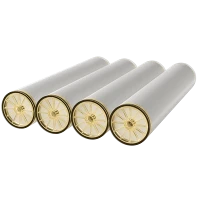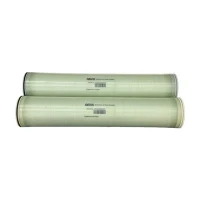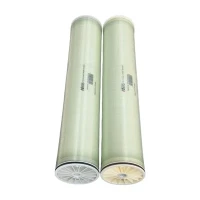

With its compact structure, high flux, and adjustable separation precision, spiral wound membranes have become an indispensable core separation element in modern industry and water treatment. Their applications cover a wide range of scenarios, from basic public welfare to high-end industrial upgrading, continuously promoting efficient resource utilization and green development.
In the water treatment field, spiral wound membranes are the main technology for desalination and purification. Reverse osmosis (RO) spiral wound membranes can achieve seawater desalination and brackish water desalination, producing freshwater that meets drinking or industrial standards; nanofiltration (NF) spiral wound membranes can efficiently retain organic matter, heavy metals, and some salts in the advanced treatment of drinking water, improving water quality safety; ultrafiltration (UF) spiral wound membranes are used for the pretreatment of municipal sewage and industrial wastewater, removing suspended solids, colloidal and macromolecular pollutants, reducing the load on subsequent processes.
In the food and beverage industry, spiral wound membranes contribute to quality improvement and resource recycling. Juice clarification uses ultrafiltration spiral-wound membranes to remove turbidity such as pectin and protein while retaining flavor compounds; whey protein concentration utilizes nanofiltration spiral-wound membranes to recover high-value proteins with low energy consumption, reducing dairy waste emissions; and wine refining uses reverse osmosis spiral-wound membranes to adjust alcohol content and flavor components, optimizing product consistency.
In the biopharmaceutical field, where separation precision and cleanliness requirements are stringent, spiral-wound membranes play a crucial role. The purification of antibiotics and peptide drugs can achieve efficient solid-liquid separation using solvent-resistant spiral-wound membranes; in biopharmaceutical production, ultrafiltration spiral-wound membranes are used for virus removal and protein concentration, ensuring drug safety and efficacy; and the purification of traditional Chinese medicine extracts also relies on nanofiltration spiral-wound membranes to remove large molecular impurities, improving the purity of extracts.
In the chemical and energy industries, spiral-wound membranes support zero-discharge of high-salinity wastewater and resource recycling. Electrodialysis spiral wound membranes achieve the separation of salts and organic matter in the treatment of high-salt organic wastewater, reducing energy consumption for evaporation and crystallization. Organic solvent recovery utilizes solvent-resistant spiral wound membranes to retain solutes, reducing hazardous waste generation and recovering useful components. Oil and gas extraction wastewater treatment employs fouling-resistant spiral wound membranes to remove oils and suspended solids, meeting reinjection or discharge requirements.
With technological advancements, the application of spiral wound membranes in emerging fields such as new energy battery recycling and electronic-grade ultrapure water preparation continues to expand, and their diverse uses are profoundly reshaping the efficiency boundaries of separation engineering.