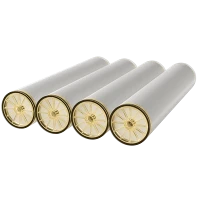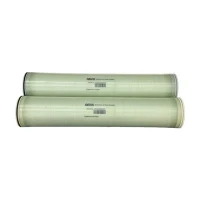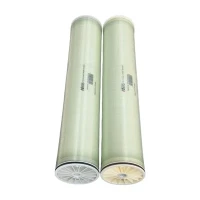

As one of the mainstream configurations in membrane separation technology, spiral wound membranes benefit from precise structural design and material synergy, resulting in significant advantages in separation efficiency, space utilization, and adaptability to various operating conditions, making them the preferred solution for large-scale industrial separation.
The primary feature is a large membrane area per unit volume. Through a process of alternating layers of membrane, flow guide mesh, and membrane wound along a central tube, spiral wound membranes maximize the effective membrane area within a limited space, increasing it by more than 30% compared to plate and frame membranes. This is particularly suitable for high-flow-rate continuous processing scenarios, significantly reducing equipment footprint and investment costs.
Secondly, they offer high separation flux and stable operation. The mesh structure of the flow guide mesh creates moderate turbulence in the feed flow, effectively mitigating concentration polarization and reducing contaminant deposition on the membrane surface. Combined with the mechanical reinforcement of the support layer, this ensures slow flux decay during long-term operation, making it suitable for 24/7 continuous operation.
Furthermore, they offer a wide range of separation precision coverage. Based on membrane material and pore size control, multi-scale separation from the micron level (microfiltration) to the nanometer level (reverse osmosis) can be achieved. It can retain small molecules such as heavy metal ions and salts, as well as separate large particles such as colloids and proteins, meeting the diverse needs of various fields such as water treatment, food, pharmaceuticals, and chemicals.
Its structure also provides excellent adaptability to operating conditions. By selecting acid and alkali resistant, high-temperature resistant, or fouling-resistant membrane materials, spiral wound membranes can withstand highly corrosive environments with pH 1-13, high temperatures above 80℃, or complex feed solutions with high suspended solids content, maintaining stable performance in harsh scenarios such as seawater desalination, high-salinity wastewater treatment, and biopharmaceutical purification.
Furthermore, spiral wound membrane modules have a high degree of standardization, facilitating modular combination and system expansion, and can flexibly match different treatment scales, reducing engineering integration difficulty. These characteristics collectively establish its key position in resource recycling, clean production, and high-end manufacturing, continuously driving the development of separation technology towards higher efficiency and greater efficiency.