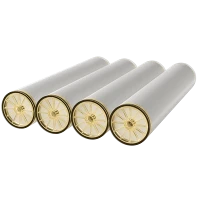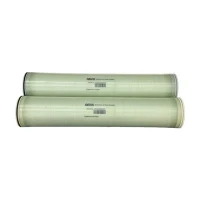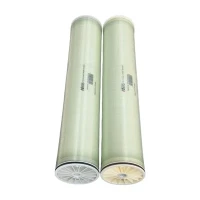

High-pressure membranes occupy a crucial position in membrane separation technology. Their practicality lies in their ability to stably, economically, and efficiently solve challenging separation problems, widely serving key areas such as water resource development, industrial treatment, and high-end manufacturing. Their design aims to maintain high selectivity, high flux, and long lifespan under high-pressure environments, enabling the achievement of many process goals that are difficult to reach with traditional methods.
Practicality is primarily manifested in their adaptability to high-concentration, high-osmotic-pressure feed solutions. In seawater desalination and brackish water desalination, the salt content of raw water can reach tens of thousands of milligrams per liter. Conventional low-pressure membranes cannot overcome such high osmotic pressure, while high-pressure reverse osmosis membranes, under pressures of several megapascals or even higher, can force water molecules to permeate, retaining the vast majority of salt and stably outputting freshwater that meets drinking or industrial standards. This capability provides a reliable water supply route for water-scarce coastal areas and inland high-salinity sources.
In zero-discharge or near-zero-discharge industrial wastewater processes, high-pressure membranes can concentrate high-salt organic wastewater to near-crystallization conditions, significantly reducing subsequent evaporation energy consumption and enabling water reuse. For complex systems such as landfill leachate and coal chemical wastewater, high-pressure membranes combine anti-fouling and high retention characteristics, ensuring continuous effluent compliance and reducing the risk of secondary pollution. Their acid and alkali resistance, temperature resistance, and solvent resistance expand their application scope in harsh environments such as chemical and pharmaceutical industries.
Economic efficiency is also a crucial aspect of their practical advantages. High-pressure membranes have a large membrane area and high flux per unit volume, enabling large-scale treatment with relatively small equipment sizes, saving space and investment. Cross-flow filtration and anti-fouling design extend cleaning cycles, reducing operation and maintenance costs. In resource recovery, high-pressure membranes are used for the extraction of rare elements such as lithium and potassium and the recovery of organic solvents, improving the recovery rate of valuable components, turning waste into treasure, and enhancing the circular economy competitiveness of enterprises.
Furthermore, the standardized components of high-pressure membranes facilitate modular integration and system expansion, allowing for flexible configuration according to treatment scale, shortening construction cycles and reducing technical risks. Its mature application cases and reliable performance have already demonstrated a demonstrative effect in municipal, energy, and pharmaceutical fields.
In summary, high-pressure membranes, with their high-efficiency separation, robust operation, economic feasibility, and wide applicability, have become a core technology supporting water resource security, clean industrial production, and high-end separation needs, demonstrating significant practical value and continued potential for widespread adoption.