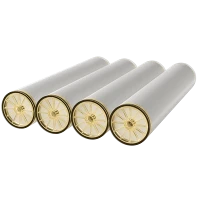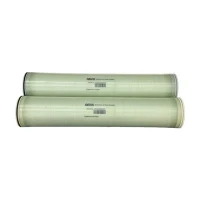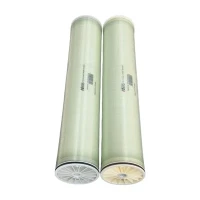

Against the backdrop of water scarcity, escalating environmental pollution, and the increasingly urgent need for resource recycling, high-pressure membranes, with their unique performance and innovative applications, have become a crucial technological pillar supporting modern industry and people's livelihoods, demonstrating significant economic, environmental, and strategic value.
The primary value of high-pressure membranes lies in overcoming the bottlenecks of highly challenging separation processes. Faced with high-salt, high-osmotic-pressure feed solutions such as seawater, conventional low-pressure membranes struggle to achieve effective desalination. High-pressure reverse osmosis membranes, operating at pressures of several megapascals or even higher, can force water molecules through a dense separation layer, retaining the vast majority of ions and impurities, and stably producing freshwater that meets drinking or industrial standards. This not only alleviates water supply pressures in coastal areas and inland brackish water regions but also provides a scalable technological path within the global water security framework.
In the industrial sector, high-pressure membranes are key to achieving zero discharge and resource recovery of high-salt wastewater. High-salt organic wastewater from industries such as chemical, power, and metallurgy can be significantly reduced in subsequent evaporation and crystallization energy consumption after high-pressure membrane concentration, allowing freshwater to be reused in production and reducing fresh water consumption and wastewater discharge burden. Its efficient retention of heavy metals and recalcitrant organic matter also reduces environmental risks, helping enterprises achieve clean production and circular economy goals. This process not only saves energy and water resources but also enhances economic benefits through the recovery of valuable substances.
Biomedicine and fine chemicals have stringent requirements for separation purity. High-pressure membranes can achieve high-precision separation of active pharmaceutical ingredients and impurities under high pressure, ensuring product quality and yield. In scenarios such as traditional Chinese medicine extraction and solvent recovery, its solvent resistance and anti-fouling properties further expand its application boundaries, reducing hazardous waste generation and lowering production costs.
From a strategic perspective, the large-scale application of high-pressure membranes has driven the development of membrane separation technology towards low-energy consumption and intelligentization. The widespread adoption of energy recovery devices and the improvement of membrane material performance have continuously optimized system energy efficiency; standardized components and modular designs have lowered the barriers to technology promotion, accelerating the implementation of advanced separation technologies in municipal, energy, and resource development fields.
The value of high-pressure membranes lies not only in their efficient separation capabilities, but also in their role as a link between technological innovation and sustainable development. They provide practical solutions for addressing the global water crisis, industrial pollution control, and efficient resource utilization, and their economic, social, and environmental benefits will continue to be released, making them an important engine in the green transformation process.